Holding Korean citizenship offers no immunity in US criminal proceedings, but could complicate the process if he is in S. Korea and refuses to cooperate with US authorities

As rumors about the identity and background of a Korean defendant in the alleged gang rape case at Cornell University spread online, questions are also mounting over his citizenship status and its potential legal implications.
A person surnamed Lee is one of seven current and former Cornell University students named as defendants in a civil lawsuit over the alleged gang rape of a former student at the Chi Phi fraternity house in October 2024, according to The Cornell Daily Sun.
No charges were filed against the seven students at the time, after prosecutors concluded that the evidence gathered in the initial police investigation did not support criminal charges.
The case, however, took a new turn this week when Tompkins County District Attorney Matthew Van Houten announced that his office had reopened the criminal investigation and would present it to a grand jury to decide whether to bring criminal charges, local news reports said.
Attention in South Korea has focused on Lee, whose nationality and background remain unknown. Online users have combed through his old social media accounts, circulating photos and videos that they claim show him serving in the South Korean Army. Some have speculated that he may hold South Korean or dual US-South Korean citizenship, or even be the son of a former South Korean prime minister.
Neither Lee nor his legal representatives have confirmed or denied claims about Lee’s military service, family background or citizenship.
Will Lee's citizenship matter?
Lee's citizenship status — whether Korean, American or both — should not affect the New York authorities' ability to investigate or prosecute him, if warranted, according to a Seoul-based lawyer surnamed Kim, who was admitted to the New York State Bar in 2024.
Under New York’s Criminal Procedure Law, criminal jurisdiction generally turns on where the alleged offense occurred and the conduct involved, rather than the defendant’s nationality.
"If Lee is currently in the US, his nationality would not prevent New York authorities from investigating or prosecuting him over the alleged incident at Cornell, regardless of whether he is a US citizen, a South Korean citizen or a citizen of both countries," Kim told The Korea Herald.
Lee is currently listed as an enrolled student in Cornell's university directory, with reports suggesting that he has returned to campus and resumed classes.
But the situation could become more complicated if Lee is currently in South Korea and refuses to travel to the US for the investigation.
To secure his return, US authorities would generally have to seek his extradition under the US-South Korea Extradition Treaty, signed by the two countries on June 9, 1998. Extradition is a formal process through which one country asks another to surrender a person for prosecution, trial or punishment.
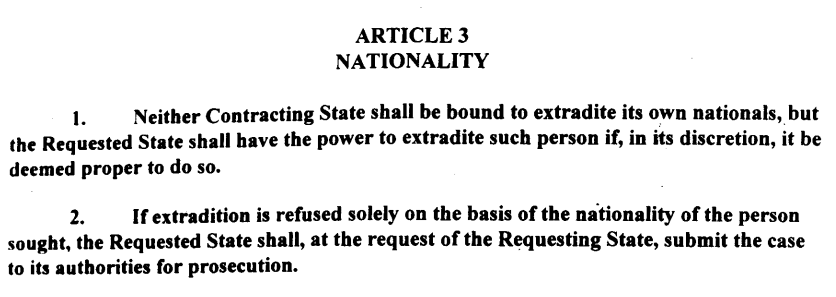
Kim noted that Lee's nationality could become relevant at this stage.
"Article 3 of the treaty makes clear that neither South Korea nor the US is required to extradite its own citizens, although each country has the discretion to do so," he said.
"However, a refusal to extradite Lee because of his Korean citizenship would not necessarily mean the case ends there. If the US requests it, South Korea would have to refer the case to its own authorities to consider whether to prosecute him in Korea."
cjh@heraldcorp.com


![[Legal updates in Korea] New insurance mandate protects firefighters on the job](https://wimg.heraldcorp.com/news/cms/2026/10/01/news-p.v1.20261001.76835f19eb424f18814ac3bb65d896a9_T1.jpg?type=h&h=800)